
Most people assume a neck lift is simply about removing loose skin. That misunderstanding leads to disappointment, mismatched expectations, and sometimes the wrong treatment choice altogether. Understanding why neck lift surgery done correctly addresses far more than surface laxity is what separates patients who are thrilled with their results from those who feel let down. This article covers the structural causes of neck ageing, what the surgery actually corrects, how it compares to non-surgical options, and what recovery genuinely looks like so you can make a properly informed decision.
Table of Contents
- Key takeaways
- Why neck lift surgery is done: the anatomy behind it
- What a neck lift actually corrects
- Surgery versus non-surgical treatments
- Benefits and risks worth knowing
- Recovery: what to expect
- My perspective on what patients often miss
- Considering a neck lift with Professor Sandip Hindocha
- FAQ
Key takeaways
| Point | Details |
|---|---|
| Surgery targets structure, not just skin | Neck lift surgery corrects platysma muscle laxity and deep fat deposits, not only loose skin. |
| Cervicomental angle is the true goal | Restoring the angle between chin and neck to 90°–105° defines a youthful, well-defined neckline. |
| Non-surgical options have real limits | Machines and injectables improve skin quality mildly but cannot fully correct structural neck ageing. |
| Surgeon skill determines outcome quality | Overcorrection, including cobra neck deformity, is a real risk without precise anatomical technique. |
| Recovery takes weeks but results last years | Surgical recovery is longer than non-invasive treatments, but the improvement is significantly more lasting. |
Why neck lift surgery is done: the anatomy behind it
The neck ages in layers. Most people focus on what they can see, which is the skin, but the changes happening beneath the surface are what actually drive the aged appearance. Neck lift surgery addresses structural ageing by tightening the platysma muscle, removing excess skin and fat, and restoring the jawline in a way that purely topical or energy-based treatments cannot replicate.
The platysma is a thin sheet of muscle that runs from the chest up through the neck to the lower face. As it ages, it loses tension and the two sides of the muscle begin to separate, creating vertical bands down the front of the neck. This is what produces the classic “turkey neck” appearance. Skin laxity follows, but the muscle change comes first.
Key structural changes that contribute to neck ageing include:
- Platysma laxity: The muscle bands separate and sag, creating visible cords and a loss of definition.
- Submental fat accumulation: Fat deposits beneath the chin and in the deep neck obscure the jawline and cervicomental angle.
- Skin redundancy: Once muscle and fat have shifted, the overlying skin stretches and loses its ability to retract.
- Skeletal resorption: Bone volume in the jaw and chin reduces with age, which removes the structural support the soft tissues rely on.
- Submandibular gland descent: The salivary glands can shift downward, contributing to fullness along the jaw that fat removal alone will not fix.
Pro Tip: If you notice prominent vertical neck bands alongside loose skin, that is a strong indicator that muscle correction will be needed. A surgeon who only addresses skin in this scenario will leave you with a result that looks incomplete within a few years.
Understanding these layers matters because it directly shapes what surgery can and cannot achieve. Addressing platysma laxity and deeper fat is crucial, as the neck structurally frames the face and has a significant impact on perceived age.
What a neck lift actually corrects
A neck lift is not a single technique. It is a combination of procedures tailored to what each patient’s anatomy requires. The surgical objectives follow a logical sequence:
- Platysmaplasty: The platysma muscle is tightened and the two sides are sutured together at the midline. Muscle laxity correction is considered essential for a youthful neck shape and is the component that most distinguishes surgery from any non-surgical approach.
- Submental fat removal: Excess fat beneath the chin is removed through liposuction or direct excision. The amount removed must be carefully judged.
- Deep fat management: Fat pockets deeper in the neck may also be addressed, particularly where they obscure the cervicomental angle.
- Skin redraping and excision: Once the underlying structures are corrected, redundant skin is trimmed and redraped without tension.
- Incision closure: Incisions are typically placed beneath the chin and behind the ears, where scarring is well hidden.
The primary geometric goal of the surgery is to restore a cervicomental angle of 90° to 105°. This is the angle formed between the underside of the chin and the front of the neck. A sharper, more defined angle is the visual marker of a youthful neck. Careful evaluation of this angle guides the extent and specific techniques used throughout the procedure.
One risk that deserves honest discussion is cobra neck deformity. Over-removal of submental fat can hollow the neck and create an unnatural, gaunt appearance. This is why precision matters far more than aggression. The goal is anatomical restoration, not maximum tissue removal.

Pro Tip: Ask any surgeon you consult with how they approach the cervicomental angle specifically. A surgeon who talks only about skin removal without mentioning muscle correction or fat management is not giving you the full picture.
| Technique | What it corrects | Why it matters |
|---|---|---|
| Platysmaplasty | Muscle banding and neck cord visibility | Addresses the root cause of “turkey neck” |
| Submental liposuction | Double chin and blurred jawline | Restores definition beneath the chin |
| Skin excision | Redundant, sagging skin | Removes excess after deeper correction |
| Deep fat removal | Fullness obscuring neck angle | Sharpens the cervicomental angle |
Surgery versus non-surgical treatments
This is where many patients find themselves confused, and where honest comparison genuinely helps. Non-surgical treatments such as radiofrequency, ultrasound-based tightening, and anti-wrinkle injectables have a real place in cosmetic care. They work well for mild laxity, early-stage ageing, and maintenance. But they have structural limits that surgery does not.
A surgical neck lift is the only true method to fully remove excess neck skin. Non-invasive options consistently leave residual looseness because they cannot reposition or remove tissue. They stimulate collagen, which improves skin quality modestly, but they do not tighten the platysma or remove fat deposits in any meaningful quantity.
Many patients are disappointed with non-surgical treatments precisely because they expected a lifting result and received a skin-quality improvement instead. The distinction sounds subtle but the visual difference is significant.
Surgery is the recommended option when:
- Visible platysma bands are present
- There is moderate to significant skin redundancy
- Previous non-surgical treatments have not delivered satisfactory results
- The cervicomental angle is noticeably blunted
- The patient wants a result that lasts years rather than months
Neck lifts offer longer lasting, more striking improvements than non-invasive treatments. Results from a well-performed neck lift typically last a decade or more with normal ageing continuing gradually. Non-surgical results generally require repeat treatment every six to eighteen months to maintain.
Benefits and risks worth knowing
The benefits of neck lift surgery are well established when the procedure is performed by an experienced surgeon with a sound anatomical approach.
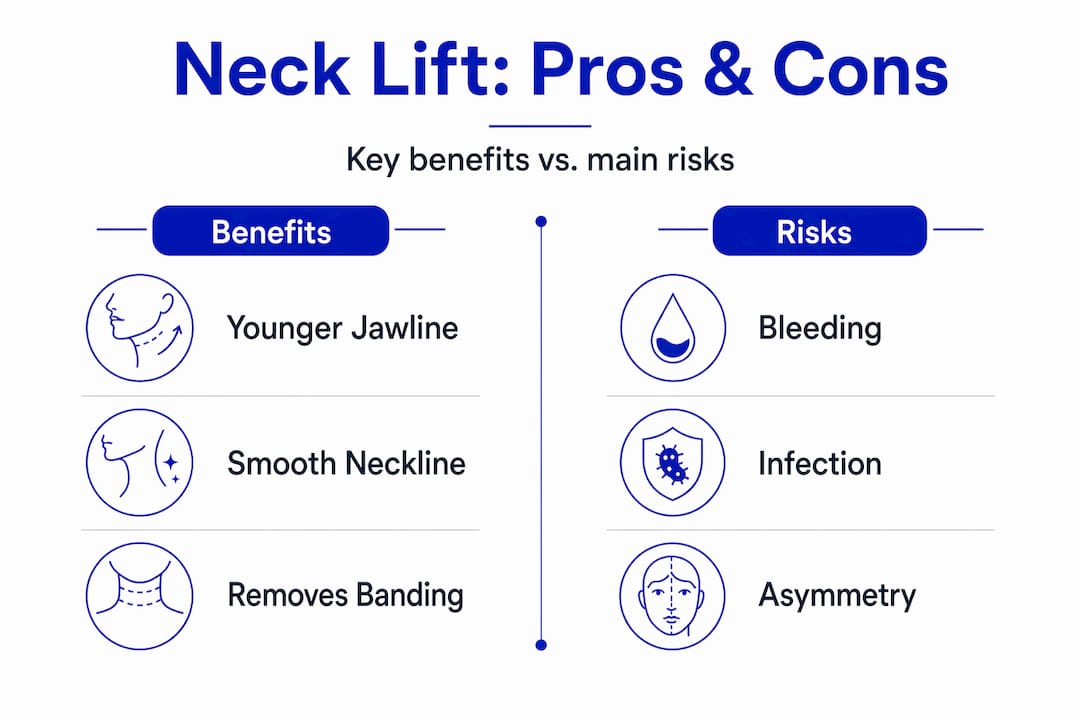
The key neck lift advantages include improved jawline definition, elimination of muscle banding, a sharper cervicomental angle, and a more rested, youthful overall appearance. Results look natural when the surgery respects the underlying anatomy rather than simply pulling tissue tight. Achieving a natural look requires repositioning of underlying muscle and fat, not skin tightening alone.
Patients frequently report that the change affects how others perceive their energy and age, not just their physical appearance. The neck is one of the first areas to show age, and correcting it has a disproportionate effect on overall facial harmony.
The risks are real and should be understood clearly. Bleeding is the most serious risk, though rare, and infection is possible as with any surgical procedure. Nerve sensitivity changes, temporary numbness, and asymmetry can occur. Cobra neck deformity, as discussed, results from overly aggressive fat removal. Surgeon expertise is critical to balancing fat and muscle surgery depth for safe, natural results and minimising complications.
Choosing a surgeon with specific experience in neck and facial anatomy is not optional. It is the single most important decision you will make in this process.
Recovery: what to expect
Surgical recovery requires weeks to months compared to the minimal downtime of non-invasive treatments, but the transformative difference in results justifies this for most patients.
Here is a realistic recovery timeline:
- Days one to three: Swelling and bruising are at their peak. A compression garment is worn around the neck and chin. Rest is required, with the head elevated.
- Days four to ten: Bruising begins to fade. Most patients feel comfortable moving around the house. Sutures are typically removed within this window.
- Weeks two to four: Visible swelling reduces significantly. Many patients return to desk-based work. Strenuous activity is still avoided.
- Months two to three: Residual swelling resolves and the final contour becomes clearer. Numbness in the neck area may persist during this phase.
- Six months onward: The result is fully settled. Scars continue to mature and fade over the following year.
Pro Tip: The extent of surgery directly affects recovery length. A combined neck and face lift will require longer downtime than an isolated neck lift. Discuss this honestly with your surgeon when planning your timeline.
Realistic outcome expectations are shaped by your starting anatomy, your age, your skin quality, and your surgeon’s skill. Realistic outcomes depend on selecting a skilled surgeon who respects subtlety and facial harmony. Patients who approach surgery with clear expectations and a qualified surgeon consistently report high satisfaction.
My perspective on what patients often miss
In my experience, the patients who struggle most with their decision are those who have spent months or years trying non-surgical options and are frustrated that nothing has delivered what they hoped for. What I have seen repeatedly is that this frustration is not about the treatments failing. It is about a mismatch between what was offered and what the anatomy actually needed.
The neck is structurally complex. When I assess a patient, I am not looking at skin first. I am looking at the platysma, the cervicomental angle, the fat distribution, and whether the submandibular glands are contributing to the fullness. Skin is the last layer I think about, because it follows everything beneath it.
What actually works is addressing the root cause. Tightening skin over a lax muscle and unaddressed fat is like repainting a wall without fixing the damp behind it. The result looks fine briefly and then the underlying problem reasserts itself.
My honest advice is this: if you are considering a neck lift, do not let the recovery timeline be the deciding factor against surgery when surgery is genuinely what your anatomy requires. The recovery is finite. The result, when done well, is not.
— Sandip
Considering a neck lift with Professor Sandip Hindocha

If this article has clarified why neck lift surgery done well goes far beyond skin removal, the next step is a consultation with a surgeon who approaches the procedure with that same depth of understanding. Professor Sandip Hindocha is a consultant plastic, reconstructive, and cosmetic surgeon with extensive experience in neck and facial surgery. His approach prioritises anatomical precision and natural-looking results, addressing the platysma, fat distribution, and cervicomental angle as a complete picture rather than treating symptoms in isolation.
Whether you are exploring a standalone neck lift or considering it alongside a face lift procedure, Sandip Hindocha offers a patient-focused consultation process that helps you understand exactly what your anatomy requires and what results are genuinely achievable. Explore the full range of plastic surgery services available, or contact the practice directly to arrange your consultation.
FAQ
What is the main reason neck lift surgery is done?
Neck lift surgery is performed to correct structural ageing in the neck, including platysma muscle laxity, excess fat deposits, and redundant skin. The goal is to restore a youthful cervicomental angle and defined jawline that non-surgical treatments cannot fully achieve.
Can non-surgical treatments replace a neck lift?
Non-surgical treatments improve skin quality mildly but cannot remove excess skin or tighten the platysma muscle. Surgery remains the only method that fully corrects structural neck ageing, particularly where visible muscle banding or significant skin laxity is present.
How long does recovery from a neck lift take?
Most patients return to light activity within two weeks and see significantly reduced swelling by weeks three to four. Full results settle over three to six months, with scars continuing to fade for up to a year post-surgery.
What are the main risks of neck lift surgery?
The primary risks include bleeding, infection, temporary numbness, and asymmetry. Overly aggressive fat removal can cause cobra neck deformity, which is why surgeon experience and anatomical precision are critical to a safe outcome.
How long do neck lift results last?
A well-performed neck lift typically delivers results that last a decade or more, with normal ageing continuing gradually. This compares favourably to non-surgical treatments, which generally require repeat sessions every six to eighteen months.