
Breast asymmetry correction addresses a genuine, visible difference in the size, shape or position of the breasts. Almost every woman has some natural variation between the two sides, but for some the gap is noticeable enough to affect confidence in clothing, swimwear or everyday life.
Prof. Hindocha treats breast asymmetry using whichever combination of augmentation, reduction, lift or fat transfer actually suits the underlying cause, rather than defaulting to one procedure for everyone.
What Causes Breast Asymmetry
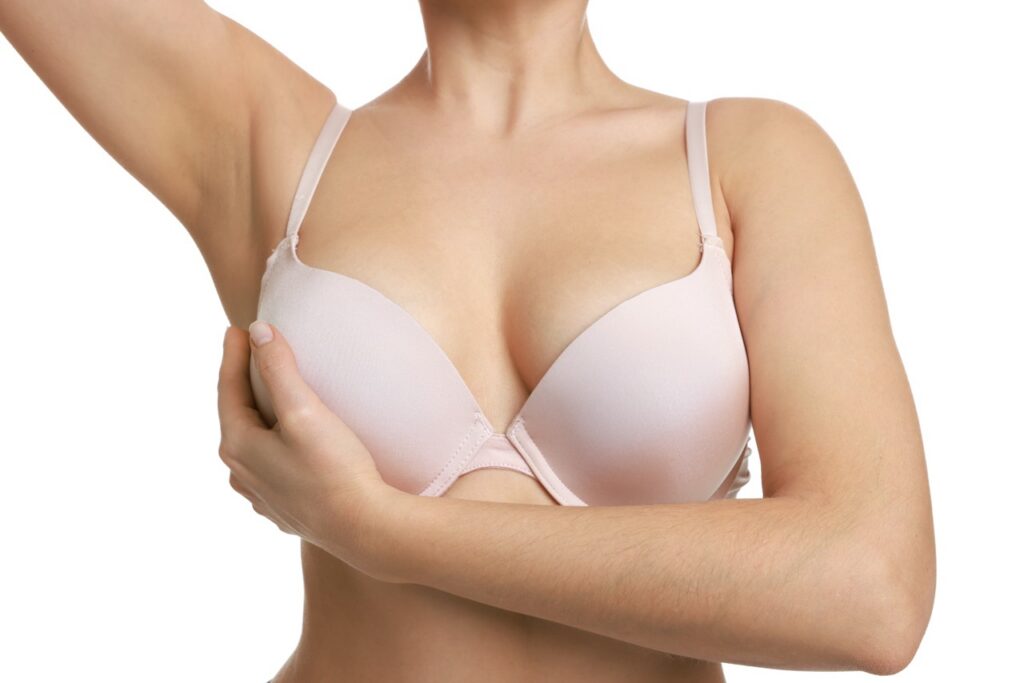
Most breast asymmetry starts during puberty, when the two breasts don’t always develop at the same rate or reach the same final size. For many women that early gap narrows with time, though it doesn’t always disappear completely.
Hormonal changes through the menstrual cycle, pregnancy and menopause can also affect each breast slightly differently, and pregnancy or breastfeeding sometimes leaves one side fuller than the other afterwards. Weight gain or loss rarely distributes evenly either.
Less commonly, a more noticeable difference comes from a developmental condition such as tuberous breast deformity or Poland syndrome, or from previous injury or surgery to the chest. In many cases there’s no single identifiable reason, it’s simply how that person’s chest and breast tissue developed.
How Much Asymmetry Is Normal
Some degree of unevenness in size, shape, nipple position or volume is genuinely common. Most women have it to a small extent without ever thinking of it as a problem.
Correction tends to become relevant when the difference is visible in fitted clothing or swimwear, makes bra fitting difficult, or affects how confident someone feels day to day. There’s no fixed cup size difference that automatically means surgery is the right answer, it comes down to how much it bothers the individual.
Treatment Options for Breast Asymmetry Correction
The right approach depends entirely on where the difference actually lies, in size, shape, position or a combination of the three. A consultation is the only reliable way to work out which of the following suits your own anatomy.
Breast Augmentation

Breast augmentation places an implant in the smaller breast to bring its volume in line with the other side. It suits cases where the shape and position of both breasts are already reasonably similar and the main issue is size.
Breast Reduction
A reduction removes excess tissue from the larger breast, and can reposition or resize the nipple and areola at the same time if that’s also uneven, detailed further on the breast reduction page. It’s the better option when one breast is simply larger than the other, sometimes alongside physical discomfort such as back or neck pain.
Breast Lift (Mastopexy)
A lift reshapes and repositions breast tissue that’s already there, without significantly changing volume, covered in more depth under breast lift. It suits asymmetry that’s mainly about shape or nipple position rather than size, and is often the right fix after pregnancy or breastfeeding has left one breast sitting lower than the other.
Fat Transfer
Fat transfer uses liposuction to take fat from elsewhere on the body and inject it into the smaller breast. It gives a gentler, more modest volume correction than an implant, though it depends on having enough donor fat available and sometimes needs more than one session to get right.
Combining Techniques
Many patients need more than one approach in the same operation, most often a lift combined with augmentation, which is planned in detail on the breast augmentation and lift page, where one breast needs repositioning and both need matching volume. Treating asymmetry properly usually means combining techniques accurately rather than picking a single procedure by default.
| Approach | What It Corrects |
|---|---|
| Augmentation | Adds volume to a smaller breast |
| Reduction | Removes volume from a larger breast |
| Lift (mastopexy) | Repositions and reshapes without major volume change |
| Fat transfer | Modest volume correction using your own fat |
| Combination | Addresses size, shape and position together |
How Breast Asymmetry Is Assessed

Assessment starts with a physical examination and a conversation about what’s actually bothering you, since two people with a similar-looking difference can want quite different outcomes.
Photographs and measurements help establish exactly where the difference lies and by how much, which then guides which combination of techniques is genuinely appropriate rather than assumed from the outset.
Is Breast Asymmetry Correction Available on the NHS
Occasionally, yes, but the threshold is specific rather than based on how much the difference bothers someone. NHS policy typically requires an estimated difference of at least three cup sizes, roughly 300g, confirmed by a breast specialist, or a clear tubular deformity where one breast’s base diameter is under half the size of the other, according to NHS commissioning policy on breast symmetrisation surgery.
Funding also depends on a stable BMI under 30 for at least 12 months and not smoking or using nicotine products for at least six months. Asymmetry correction carried out purely for cosmetic reasons, without meeting these criteria, isn’t routinely funded, and self-funding privately is the usual route.
Recovery After Breast Asymmetry Surgery
Recovery depends on which technique or combination is used, but most procedures take between 1.5 and 3 hours under general anaesthesia as a day case, with drains rarely needed.
| Timeframe | What to Expect |
|---|---|
| Week 1 to 2 | Follow-up appointments, rest, supportive bra worn at all times |
| Week 2 to 3 | Return to light, desk-based work |
| Week 4 | Return to moderate activity, avoiding heavy lifting |
| Week 6 | Full recovery, gym and normal activity resume |
Scars from any of these techniques are placed within natural breast contours where possible, and typically fade significantly over 12 to 18 months.
Breast Asymmetry Treatment With Prof Hindocha

Prof. Hindocha’s approach to breast asymmetry correction starts with an individual assessment rather than a standard package, agreeing the exact technique, or combination of techniques, at consultation before anything is booked.
Good candidates have completed breast development, are at a stable weight, are in good general health and have realistic expectations about what correction can achieve. A consultation is the only way to find out what applies to your own anatomy.
Frequently Asked Questions
What causes breast asymmetry?
Most breast asymmetry develops naturally during puberty, when the two breasts grow at slightly different rates, or from hormonal changes, pregnancy and breastfeeding, and weight fluctuation. Less commonly it comes from a developmental condition or previous injury or surgery.
How much breast asymmetry is normal?
Some degree of unevenness in size, shape or nipple position is genuinely common and doesn’t need treatment. Correction becomes relevant once the difference is visible in clothing or affects confidence, rather than at any fixed measurement.
What is the best treatment for breast asymmetry?
There isn’t one single best treatment, it depends on whether the difference is mainly in size, shape or position. Augmentation, reduction, a lift, fat transfer or a combination can all be the right answer depending on the individual case.
Is breast asymmetry correction available on the NHS?
Occasionally, where the difference meets specific clinical thresholds such as an estimated three cup size gap confirmed by a specialist, or where it results from a recognised developmental condition. Cosmetic asymmetry outside those criteria isn’t routinely funded.
Will there be visible scarring?
Scar placement depends on the technique used. Augmentation typically leaves a small scar within the breast fold, while reduction and lift procedures involve more extensive incisions around the areola and down the breast, and scars generally fade well over 12 to 18 months.
How long is recovery after breast asymmetry surgery?
Most patients return to light work within two to three weeks and to full activity, including the gym, by around six weeks. A supportive bra is worn throughout the early recovery period.
If you’re noticing a real difference between your breasts and want to know what breast asymmetry correction would actually involve for your own anatomy, book a consultation with Prof. Hindocha for an honest, individual assessment.
This article is for general information only and does not constitute medical advice. Individual results vary, and suitability for any procedure can only be confirmed following an in-person consultation with a qualified, registered clinician.